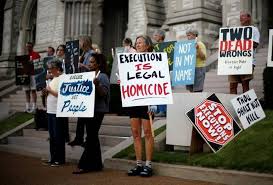
The pro-death or pro-death penalty movement has been around for a whopping century. Debates about whether or not the death penalty should be legalized have been at the center of attention of passionately heated discussions. After going through thorough research, all evidence has pointed towards one conclusion. Capital punishment should be abolished because it is ineffective, is ethically wrong as it falsely accuses the innocent, and goes against the teachings of Christianity.
The main justification for the death penalty is the fact that it successfully deters crime rates. Contrary to this, there are many cross-sectional studies that show that there is actually no reduction in homicide rates due to the death penalty, states Paul Rubin in the academic journal Does Capital Punishment Have a Deterrent Effect? One of the studies done by Brumm and Clonginger in Does Capital Punishment Have a Deterrent Effect? showed that the death penalty negatively correlated with the rates of homicide, according to data taken from 58 different American cities in 1985. Take the state of New York for example. David Von Drehle also says in the magazine article, “Capital Punishment: The End of the Death Penalty” that there are some 1900 fewer murders per year in New York City now than when capital punishment was legal. Other statistics taken by John Lamperti in Does Capital Punishment Deter Murder shows that when compared to U.S states with the death penalty, the states without the death penalty had homicide rates that averaged 63% lower. American defense attorney David J Burge said in Capital Punishment: The End of the Death Penalty, “Capital punishment is nothing more than an expensive, wasteful and risky government program.”
Not only is the death penalty ethically wrong, it also goes against the morals of many. There have been many cases of innocents wrongfully sentenced to death. Statistics taken by Pilkington in the newspaper article, US death row study: 4% of defendants sentenced to die are innocent show that 4.1% of death row inmates are actually wrongfully convicted. Though it may seem like a small number, each and every life should have equal value. There are now more than 8,000 men and women since 1970 that are falsely convicted, solemnly awaiting their death (Pilkington). A particular case that Dorsey writes in his book, Execution of the Innocent: Justification for the Abolition of Capital Punishment, happened to Patrick Croy, an innocent man who was sentenced to death but was aquitted 11 years later. Dorsey also references another case in 1990, where convicted murderer Jesse Tafero was sentenced to death and was executed shortly after. A few years later, Sonia Jacobs, his co-defendant who was also sentenced to death row, was able to be exonerated completely. It turned out that the prosecution’s crucial witness was in fact the actual murderer. If only the state didn’t carry his execution out so early, Tafero could’ve been freed and given his life back. In light of the situation the state, judge, and prosecutor did not even bother to apologize to the victim’s family. Dorsey even went on to say that having an innocent on death row can go as far as negatively impacting the victim’s family. They are helpless and can only mournfully anticipate their beloved’s death.
Religion should be considered as an important factor when contemplating the death penalty, especially when Christianity comprises an overwhelming 70.6% of the United States population (Religion in America: U.S. Religious Data, Demographics and Statistics). In Romans 13:9, it tells us to love our neighbors as ourselves. Jesus taught us to have forgiveness and compassion for others, no matter how much wrong they have done you. In addition, 1 John 1:9 says that if we are willing to confess our sins to God, He is faithful and will forgive us. If only we take the initiative to seek out His forgiveness, then the death penalty will not be necessary. We shouldn’t have the right to take another’s life (Exodus 21:13), because only God has the right to create and destroy life. We are also told in Daniel 9:9 that God is merciful, despite us disobeying and going against His commands countless times. In Psalm 75:7, it says that God is the ultimate judge, meaning that he is the only one with the power to determine right and wrong. The death penalty should not be utilized as an excuse to openly take one’s life, despite the law saying otherwise.
Many pro-death supporters might argue that the Old Testament of the Bible actually supports capital punishment. They further back this up by quoting Genesis 9:6, “Whoever sheds the blood of man, by man shall his blood be shed.” The Israelites were required to use blood sacrifice to redeem their sins in the olden days. There are plenty of other accounts in the Old Testament that are for the death penalty, but this is just one of the many examples. However, in the New Testament of the Bible, it states that God gave his one and only Son to die for our lives. Since Jesus acted as the ultimate blood sacrifice for our sins, it means that He does not require any more blood recompense from us. Jesus’ gracious act of the crucifixtion eternally established human value, meaning that the need for capital punishment is nullified.
The abolition of capital punishment is still a current battle between pro-death supporters and anti-death supporters. Due to the lack of significant evidence to prove that the death penalty effectively deters crime, the fact that it is against God’s law, and that it’s morally wrong, the death penalty should be abolished. Humans should live as compassionate and loving beings, learning to take the high road when given the opportunity. Using evil to repay evil will not undo what has already been done.
Writing Process and Rough Draft
Reflection: Through writing this research paper, I was able to gain three main takeaways. I learned how to properly use citations and evidence to back up the thesis that I have crafted (both of which are helpful for writing research papers in the future!). I also learned that we shouldn’t make decisions without recognizing all the facts. In the case of the death penalty, one decision could ultimately change the course of someone’s lfie. Lastly, I learned that in order to seek an answer from God, you have to look at the whole picture (from the Bible) instead of just quoting verses from certain chapters.
 Samantha's College Writing Blog